Your Leading Zhongshili International Trade Co., Ltd. Supplier


We are the only company in Liaoning Province that has the import and export qualification for endangered plants granted by the Chinese government.

We focus on the introduction, propagation and cultivation of high-quality living plants and endangered plants. We currently have Multiple planting bases, Guangdong, Fujian, Yunnan, Dalian and Shandong. We strive for the most environmental.


Why Choose Us?


24h online service
Here you can ask any question about indoor plants Aeonium and our experts will give you a satisfactory answer, feel free to write us an email with your valuable comments.
 

One-stop solution
We can handle customs clearance procedures, endangered plant certificates, phytosanitary certificates, and certificates of origin on behalf of you.
 

Abundant varieties are available
We insist on continuous innovation and introduction of new varieties, which can meet different market demands. The prices are reasonable. Welcome to purchase.
 

High quality
We ship directly from the nursery to your doorstep to uphold the quality you deserve. Let our professional growers build the roots & put in the work that sets your garden up for success!

  • Aeonium Do You Know Single Cut

    Aeonium 'Do You Know' is an elegant and popular succulent with neat, compact single rosette. The leaves are slender, smooth and well-arranged, showing soft and beautiful color in good light and

  • Aeonium Voodoo Variegated

    Aeonium 'Voodoo' Variegated is a rare and precious variegated succulent with striking color contrast. It has large, broad leaves with stable white, cream and dark purple variegation, forming a

  • Aeonium Alice Single CUT

    Aeonium 'Alice' is an elegant and popular succulent with neat, standard single rosette. The leaves are smooth, well-arranged, and show attractive color under sufficient light and temperature

  • Aeonium Qingcheng Crested

    Aeonium 'Qingcheng' Crested is a rare and precious crested succulent variety. It has a unique fan-shaped or banded growth form, with dense and layered leaves. The color is elegant and soft, showing

  • Aeonium 'Lotus Cluster'

    Aeonium 'Lotus Cluster' is a beautiful and distinctive succulent known for its dense, multi‑headed growth habit. It forms numerous compact, standard lotus‑shaped rosettes on branching stems, creating

  • Aeonium 'Charming Golden Rose'

    Aeonium 'Charming Golden Rose' is a stunning succulent cultivar known for its rose‑like rosettes and striking color shifts. Its thick, fleshy leaves are tightly arranged in a compact, cup‑shaped

  • Aeonium 'Pretty Lady'

    Aeonium 'Pretty Lady' is a delicate and beautiful succulent with compact, neat rosettes. Its leaves are slender and smooth, with soft pink and light green color when grown in bright light and proper

  • Aeonium 'Moon Fairy'

    Aeonium 'Moon Fairy' is an elegant and popular succulent with beautiful rosettes. Its leaves are slender, neatly arranged, and show soft pink and green tones when grown in bright light with

  • Aeonium 'Pink Beauty

    Aeonium 'Pink Beauty' is a charming and popular succulent with soft pink and light green rosettes. The leaves are compact, plump, and neatly arranged, showing bright and lovely color under sufficient

  • Aeonium 'Pink Fairy

    Aeonium 'Pink Fairy' is a rare and beautiful variegated succulent, a mutation of Halloween Aeonium. It features plump, rounded leaves with striking pink-orange variegation along the margins, creating

  • Aeonium Peacock Tail

    Aeonium 'Peacock Tail' is an elegant and distinctive succulent cultivar with slender, layered leaves that spread gracefully like peacock feathers. The rosette is full and well-arranged, displaying

  • Aeonium 'Neptune'

    Aeonium 'Neptune' is a high-value and popular ornamental succulent with strong market demand. It features large, majestic rosettes, thick and broad leaves, and rich, deep coloration, making it highly

First 1234567 Last
What is Aeonium?


Aeonium, the tree houseleeks, is a genus of about 35 species of succulent, subtropical plants of the family Crassulaceae. Many species are popular in horticulture. While most of them are native to the Canary Islands, some are found in Madeira, Cape Verde, Morocco, in East Africa (Ethiopia, Somalia, Uganda, Tanzania and Kenya) and Yemen.


Benefits of Aeonium


Low maintenance
One of the biggest advantages of aeonium is its low maintenance requirements. Once established, this plant can thrive with minimal care. It's particularly suited for busy individuals or those new to gardening. Basic requirements include occasional watering, sufficient sunlight, and well-draining soil.


Pest resistance
Aeonium is relatively pest-resistant, which means you won't have to spend much time dealing with common garden nuisances. This makes it an excellent option for hassle-free gardening. Its natural resilience can lead to fewer interventions, allowing you to enjoy a beautiful, thriving garden with minimal effort.


Soil stabilization
Aeonium has a robust root system that helps stabilize the soil. This feature is particularly useful for preventing erosion in sloped gardens or areas prone to soil degradation. By planting haworth's aeonium, you can contribute to healthier soil and a more sustainable gardening practice.


Air purification
Like many plants, aeonium can help purify the air by absorbing pollutants and releasing oxygen. Having this plant in your home or garden can improve air quality, making your environment healthier to live in. This is especially beneficial for urban settings where clean air can be limited.


Drought tolerance
One of the standout features of aeonium is its exceptional drought tolerance. This makes it an ideal choice for xeriscaping—a landscaping method focused on reducing the need for irrigation. By incorporating aeonium into your garden, you can minimize water consumption without sacrificing aesthetics. This not only conserves an essential natural resource but also reduces your water bill.


Types of Aeonium
Portulacaria Afra
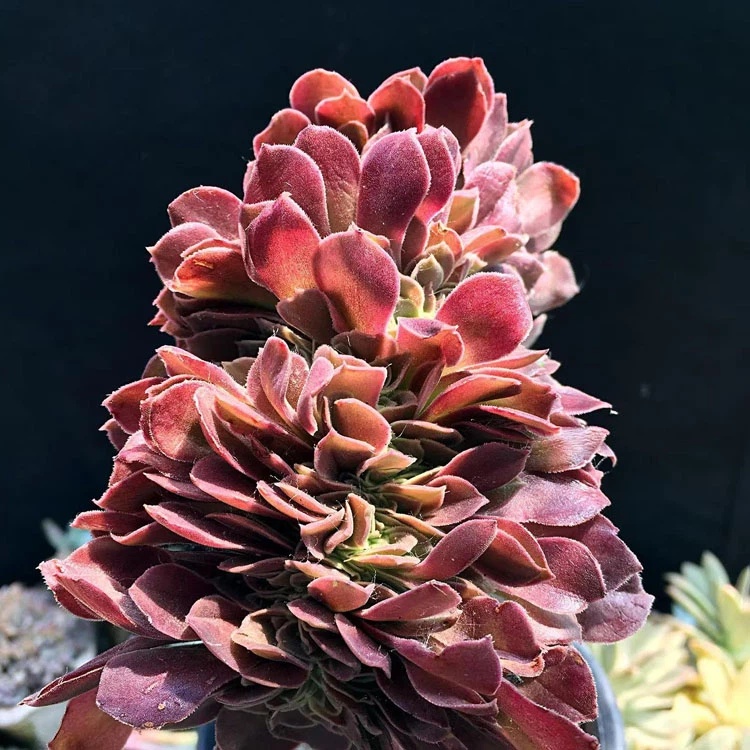
Aeonium Arboreum 'Velour European' Cristata
Aeonium Arboreum Velour Cristata
Aeonium O'Carie Var Cristata

Aeonium arboreum: This widely available plant has bright green rosettes on a branching stem. It has a shrubby form and can grow as tall as 6 feet in the garden, or 3 feet in containers.


Aeonium arboreum 'atropurpureum': This 3- to 5-foot tall cultivar has maroon leaves if grown in bright light.​


Aeonium arboreum 'zwartkop' or 'black rose': This cultivar has very dark, deep burgundy or almost black leaves.​ it, too, is a fairly large plant.


Aeonium 'garnet': A hybrid cross of a. 'zwarkop' and a. Tabuliforme, this variety's leaves are green toward the middle and tipped with dark red.


Aeonium davidbramwelli 'sunburst': This variety is a shorter, 1- to 2-foot tall plant but has rosettes up to 1 foot across with pale yellow, white, and green stripes, and pink tips.


Aeonium haworthii 'tricolor' or 'kiwi': An easy-growing 2- to 3-foot plant, it has 4-inch flowers that have pale yellow centers when young, maturing to red and green.


Aeonium canariense 'canary': This slow-growing plant will reach up to 24 inches tall and wide. It's known for its large, velvety rosettes.


Aeonium tabuliforme 'dinner plate': This low-growing variety has a flat and wide green rosette. It's often difficult to find.


Aeonium smithii 'smith's giant houseleek': This plant has spoon or paddle-shaped leaves. While the leaves are green, they can have streaks of brown or purple on them. This plant can reach up to 12 inches tall.


Aeonium valverdense: The rosette-shaped leaves on this species can range from green to dark maroon.


Aeonium holochrysum: This species features green leaves with brown markings. This tall plant can grow up to 3 feet tall.


Application of Aeonium

Aeoniums’ unique appearance and adaptability make them a versatile addition to your garden or home décor

1

Container gardens

Aeoniums look stunning in containers, allowing you to showcase their rosette shapes and colorful foliage. Mix and match different aeonium species for a vibrant and dynamic display.

2

Vertical gardens

Aeoniums can be incorporated into vertical gardens, adding a touch of drama and elegance to your outdoor space.

3

Interior decoration

Place aeoniums in decorative pots or planters to bring a touch of the exotic indoors. They make excellent additions to windowsills and shelves.

4

Rock gardens

Aeoniums’ natural affinity for rocky terrain makes them a perfect choice for rock gardens or alpine plantings.


Process of Aeonium


Choosing the right soil
When selecting soil for Aeonium propagation, opt for a well-draining mix. A blend of equal parts potting soil, coarse sand, and perlite, or a specific succulent and cactus mix, will suit their needs perfectly. A well-draining soil ensures that excess moisture doesn't accumulate around the roots, preventing the risk of root rot.

It's important to note that Aeoniums are native to arid regions and have adapted to survive in sandy and rocky soils. Therefore, replicating these conditions with a well-draining mix is crucial for their successful propagation. The coarse sand and perlite in the soil blend help to create air pockets, allowing water to flow through and preventing waterlogging.

Additionally, the potting soil provides essential nutrients for the Aeoniums' growth. It contains organic matter that aids in root development and provides a stable foundation for the plant to establish itself.


Selecting a suitable container
For propagating Aeoniums, choose a container that provides adequate drainage. This can be a small nursery pot or a shallow tray. A container with drainage holes at the bottom ensures excess water can escape, preventing waterlogging and potential root issues.

When selecting a container, consider the size of the Aeonium cuttings or seeds you'll be propagating. If you're starting with small cuttings, a small nursery pot would be sufficient. However, if you're working with larger cuttings or multiple plants, a shallow tray might be more practical.

It's also worth mentioning that the material of the container can affect the moisture levels. Terracotta pots, for example, are porous and allow for better airflow, reducing the risk of overwatering. Plastic containers, on the other hand, retain moisture for longer periods, so it's important to monitor the soil moisture levels more closely.

Furthermore, consider the aesthetics of the container. Aeoniums are visually striking plants, so choosing a container that complements their unique colors and shapes can enhance the overall appeal of your propagation project.


When to propagate aeonium
The ideal time to propagate Aeoniums is during the active growing season, which occurs in spring or early summer. During this time, the plants are in their healthiest state and have a higher chance of successful rooting and growth. It is important to choose a time when the weather is warm and stable, as temperature fluctuations can affect the success of propagation.

It's worth noting that Aeoniums can also be propagated during other times of the year, but the success rate may be lower. If you choose to propagate during the dormant season, it's essential to provide extra care and attention to ensure the cuttings have the best chance of survival.


Cutting and preparing aeonium for propagation
To start the propagation process, carefully select a healthy Aeonium rosette for cutting. Look for a rosette that is plump, with no signs of damage or disease. Using clean and sharp pruning shears, make a clean cut just below the rosette, ensuring to leave a few inches of stem below it. This stem will be the base from which new roots will grow.

When making the cut, it's important to use a swift and clean motion to minimize damage to the plant. Avoid crushing or tearing the stem, as this can hinder the rooting process. After cutting, it's normal for some sap to ooze from the wound. This is a natural defense mechanism of the plant and should not cause concern.

Once the cutting is made, remove any lower leaves from the stem, leaving only the top few leaves intact. This helps direct the plant's energy towards root development rather than sustaining unnecessary foliage.


Planting and nurturing the aeonium cuttings
Before planting the cuttings, allow them to dry for a couple of days. This step helps the cuts callus over, reducing the risk of rot once they are planted. Place the cuttings in a warm and dry location, away from direct sunlight. A well-ventilated area is ideal to prevent excess moisture buildup.

Once adequately dried, gently place the cuttings in a prepared container filled with well-draining soil. A mix of succulent or cactus soil with perlite or pumice works well for Aeoniums. Ensure that the container has drainage holes to prevent waterlogged soil, which can lead to root rot.

When planting the cuttings, bury the stem about an inch into the soil, making sure the rosette is above the soil surface. This allows the stem to come into contact with the soil, promoting root growth, while keeping the rosette above ground to prevent rot.

Place the container in a bright location with indirect sunlight. Aeoniums thrive in bright light but can be sensitive to intense, direct sunlight, especially during the propagation phase. It's important to strike a balance between providing enough light for growth and protecting the cuttings from scorching.

Water the cuttings sparingly to avoid overwatering, as excess moisture can lead to root rot. Aeoniums are drought-tolerant plants and prefer to dry out between waterings. It's best to water when the soil is completely dry, allowing the water to thoroughly soak the soil and then drain out through the bottom of the container.

Throughout the propagation process, it's important to monitor the cuttings for signs of root development and adjust care accordingly. With patience and proper care, you'll soon see new roots forming, signaling the successful propagation of your Aeonium cuttings.


How to Maintain Aeonium
 

Lighting
Aeonium succulents prefer full sun or partial shade-- they look and feel best right by your window! Like most succulents, you can keep your aeonium in full sun in colder climates, but for bright and potentially desert-like environments, place your pot away from the window to get a steady flow of indirect light.


Soil
Loamy soil with lots of drainage will help keep your Aeonium’s roots from rotting. You can use a traditional succulent soil mix with added perlite or mix your own succulent soil using an organic ingredient like peat moss or compost and an inorganic ingredient like gravel or perlite. Typically, Aeonium plants prefer soil mixtures with sand or perlite.


Water
Unlike most succulents, Aeonium prefers slightly wetter conditions. To avoid overwatering, water your succulent whenever the top inch of soil is dry. Your watering schedule may change depending on the season, so if you have trouble keeping track of when to water your succulents, consider using a moisture meter to help.

Even though Aeonium prefers more humid conditions, it is best to avoid misting your Aeonium plant unless you are propagating a cutting. The small spaces in between the leaves and stem on a fully-formed Aeonium will collect water from misting and provide the perfect ecosystem for mold and mildew growth on the leaves.


Temperature and humidity
Aeonium works best in Mediterranean climates-- temperate, but not too humid. For the home, a stable 65-75 degrees works best. When caring for Aeonium outside, you can encourage growth in arid climates by keeping your succulents in the shade. During especially hot summers, your Aeonium may go dormant due to high heat since their growing season is primarily in the winter and spring.


Fertilizer
You don’t necessarily need to fertilize your Aeonium for them to grow, but it’s always good to give your babies a little extra nutrients during the growing season! A liquid succulent fertilizer distilled in a one-to-one mixture with water. Use one drop of fertilizer per gallon of soil for best results.


How Can I Tell if My Aeoniums Are Getting Too Much Water?

Overwatering is a common problem for them, and it can lead to root rot and other issues. Here are some signs that your Aeoniums may be getting too much water 

Yellowing leaves
If the lower leaves of your Aeoniums are turning yellow and dropping off, it may be a sign of overwatering. The leaves may also feel soft and mushy to the touch.


Wilting or drooping
While underwatering can cause them to wilt, overwatering can also cause the leaves to droop and wilt. This is because the roots may be unable to absorb oxygen and nutrients from the waterlogged soil.


Root rot
If you notice a foul smell coming from the soil or see black, mushy roots when you remove the plant from its container, it is likely suffering from root rot. This is a serious condition that can be caused by overwatering, among other factors.


Slow growth
Overwatered Aeoniums may grow more slowly than healthy ones, as the waterlogged soil can prevent the roots from absorbing the nutrients they need.


Mold or fungus
Excess moisture can create the perfect environment for mold and fungus to grow. If you notice white or black spots on the leaves or soil, it may be a sign of overwatering.

To avoid overwatering your Aeoniums, make sure to let the soil dry out completely between waterings. Water deeply and infrequently, rather than giving the plant small amounts of water frequently. You can also improve drainage by using a well-draining potting mix and adding perlite or sand to the soil.


Growing Aeoniums: Problem Solving


Over watering is the most common cause of aeonium problems. Aeoniums come from hot, dry regions and look best when this is replicated in your house or garden.


Washed out, pale foliage could be a result of over watering. Cut back on watering, and let the compost dry out completely before watering again. You may also find that if you're growing your aeonium as a house plant, putting it outdoors in summer will restore its vibrant colour.


A rosette that is closed up, with dry leaves around the edge that are dropping off, is normal in summer. Aeoniums go dormant in hot periods.


A leggy, stretched plant is a sign that it is not getting enough light. Move it to a brighter spot.


Hairy stems are actually aerial roots. They sometimes appear naturally and are nothing to worry about. However they can be a sign that the conditions are not right for your plant. It could be that the roots below the soil are not getting enough water. Watering thoroughly, then leaving the compost to dry out should avoid this – watering little and often is not the answer, as the water needs to penetrate deep into the compost. Conversely, they could be a sign that the compost isn't free draining enough - this might be the cause if no perlite, sand or grit was added to the compost when planting. Aerial roots can also be a sign that your plant is not getting enough light, or that it is rootbound and needs repotting.


A mushy brown stem is rot, caused by too much water, especially in the colder months.


If your plant is dying back after flowering, this is normal – aeoniums are monocarpic, which means they die once they have flowered. However on branching varieties, only the rosette that produced the flower will die back. Cut off the flower head and the rosette and the rest of the plant will carry on growing.


You may spot mealybugs on the foliage – white, fluffy blobs around 5mm across. Wipe them off with a cotton pad soaked in organic insecticide.


Vine weevil can be a problem for plants grown in pots outdoors. These eat the roots unseen and the first sign you may see is a plant that is inexplicably dying. Look out for the adults on the foliage and white grubs in the compost. Remove promptly if you see any. Treat with an organic nematode drench in late August or September.


Our Factory
 

We are the only company in Liaoning Province that has the import and export qualification for endangered plants granted by the Chinese government. 


productcate-1-1


FAQ

Q: What is Aeonium used for?

A: The Aeonium plant looks perfect as an ornamental houseplant. These can be placed indoors or grown outdoors in a sunny location along your garden borders or a rock garden. The succulent looks absolutely gorgeous with other plants; for example, pair up aeonium crassulas like jade, agave, or aloe.

Q: Is Aeonium an indoor plant?

A: Grow aeoniums in pots in a sunny position outside, or in a bright spot indoors. Aeoniums store water in their leaves and stems and need very little watering. In spring and autumn, water the plant thoroughly, then allow the compost to dry out before watering again – this mimics downpours in their natural habitats.

Q: Do aeoniums like sun or shade?

A: Aeonium plants generally thrive in warm weather with lots of direct sunlight. Keep in mind that part shade might be necessary during especially hot summers, or if you are planting in desert conditions.

Q: What is the common name for Aeonium?

A: Aeonium undulatum, commonly known as saucer plant, is a succulent evergreen subshrub in the orpine family that typically grows to 2-3' tall.

Q: Is Aeonium edible?

A: And while they may not be a familiar flavor, many aeoniums are edible. You have seen these plants many times before, but you may be surprised to see just how lovely they can become, given the chance. Aeonium [ay-oh-nee-um] is a group of succulents known to the Greeks as aionos, which means ageless.

Q: What is the lifespan of Aeonium?

A: About 3 to 10 years
Lifespan: Aeonium arboreum is a monocarpic species, meaning that it dies after flowering. It is expected to live about 3 to 10 years as it reach its full maturity. Although their yellow flowers are attractive, each time they bloom, a rosette dies.

Q: Why are the leaves falling off my Aeonium?

A: Temperature and light are the twin pillars of a Tree Aeonium's comfort zone. Too much heat or direct sunlight can lead to a leaf exodus, akin to a crowd fleeing a too-cramped room. Conversely, insufficient light may lead to etiolated, or stretched-out, leaves that eventually give up the ghost.

Q: How do you make Aeonium bushy?

A: Your Aeonium may require pruning in order to encourage it to branch out. Often Aeoniums grow as a single stem with a single rosette at the top – pruning will help it to produce lateral buds which will become branching stems. It may also require pruning if it has become top-heavy.

Q: How often should I water my Aeonium?

A: Watering really depends on how fast the soil dry and if it is indoors/outdoors and the climate you live in. Overall, what I do with mine is I wait for the soil to get bone dry, then I wait a couple of more days, and then I water. For me this is about 2 weeks between waterings in the summer.

Q: How big do aeoniums get?

A: Aeonium arboreum 'Albovariegatum' – has white margined leaves. A. arboreum 'Atropurpureum' – has dark purplish-red leaves when grown in full sun (green in lower light). The plant grows up to three feet tall and produces yellow flowers from late winter to spring on mature rosettes.

Q: When should I repot Aeonium?

A: The best time to repot your Tree Aeonium is during its active growth period, which typically falls in spring or early summer.

Q: What to feed aeoniums?

A: Once a large root system has been achieved, you can begin feeding. After the first year you can then use a standard good all-round feed or a slow-release fertilizer, water in a balanced soluble feed every two months to supplement the best Aeonium growth.

Q: Why is my Aeonium leggy?

A: Aeonium arboreum is a species of succulent that has the ability to grow into a stunning multi-branched shrubby form. When grown this way Aeonium arboreum produces multiple rosettes of fleshy succulent leaves. However, in poor light or with insufficient feeding the succulent can grow tall, stretched and leggy.

Q: How often do aeoniums flower?

A: Their flowering can be somewhat unpredictable, often depending on the plant's age and location. More often than not, these plants decide to put on their floral show in late winter to early spring. When they do flower, it's a sight to behold.

Q: Can aeoniums take full sun?

A: In areas like Phoenix, Aeoniums enjoy full sun from autumn to spring but need shade in the summer. If you're in a cooler climate, your Aeonium may tolerate more sun throughout the year. Always be ready to relocate your plant to meet its changing needs.

Q: Is Aeonium toxic to humans?

A: Aeoniums, like the tree houseleek Aeonium arboreum, are non-toxic to humans. This means adults can handle these succulents without fear of poisoning. Their thick, waxy leaves may look like a snack to the uninformed, but they're as harmless as a plate of air.

Q: Can you keep Aeonium indoors?

A: Aeonium makes for great perennial garden plants in warmer climates, but you can also grow them outdoors in a pot and move them inside during colder seasons. However, you can keep them almost anywhere indoors as well.

Q: What do you do with Aeonium in the winter?

A: Providing cover for Aeoniums significantly enhances their winter survival. Ideal options include a greenhouse, porch, or conservatory to shield them from the harshest weather. Full sun and temperatures between 6 and 12 Celsius during winter are ideal.

Q: Can Aeonium be cut back?

A: "When aeoniums get leggy, cut off the tops, leaving an inch or two of stem, and throw the rest of the plant away, roots and all. Replant each rosette as a cutting. Insert it into the soil, so it sits just above the ground.

Q: Do Aeoniums have deep roots?

A: Unlike many other succulents, however, Aeoniums have shallow root systems and cannot be allowed to dry out completely. Container-grown Aeoniums need more frequent watering, so check the soil twice weekly during hot, dry weather and water whenever it feels dry one-inch below the surface.

As one of the leading aeonium suppliers in China, we warmly welcome you to wholesale bulk aeonium for sale here from our factory. All living plants and endangered plants are with high quality and competitive price.

succulent plants, Aeonium Medusa Cristata, aeonium

Send Inquiry